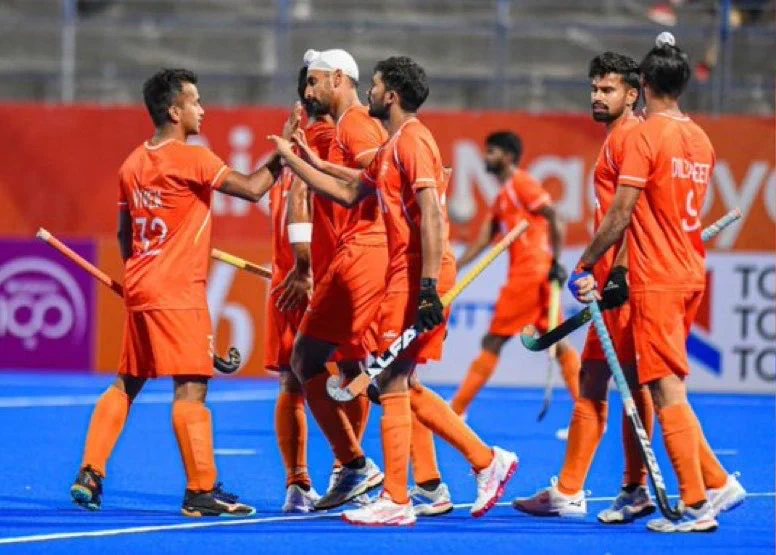
India’s men’s hockey team delivered a commanding performance in Mohali, overpowering South Korea 8-1 in the semifinal of the Hero Asian Champions Trophy Punjab 2026. The emphatic victory secured India’s place in the final and underlined the team’s attacking strength, depth and ability to convert pressure into goals. The night also carried a major individual milestone, with captain Harmanpreet Singh scoring his 250th international goal.
Shilanand Lakra and Dilpreet Singh led the scoring with two goals apiece. Harmanpreet, Sukhjeet Singh, Angad Bir Singh and Vivek Sagar Prasad contributed one goal each, giving India a result that reflected the effectiveness of its attack across different phases of the match.
India began with clear attacking intent. Lakra opened the scoring in the fourth minute, giving the hosts an early advantage. South Korea responded through Sangjun Han in the ninth minute, briefly bringing the contest level. However, India quickly regained control when Harmanpreet converted a penalty corner in the same minute. The goal not only restored India's lead but also marked his 250th senior international strike, adding historical significance to an already important semifinal.
Lakra extended the advantage in the 13th minute, reacting quickly to a rebound from a penalty corner. His second goal demonstrated the value of anticipation inside the striking circle, where a fraction of a second can determine whether an opportunity becomes a goal.
The second quarter proved decisive. Sukhjeet found the net in the 21st minute, and Dilpreet scored shortly afterwards. Dilpreet then added his second goal in the 25th minute, taking India’s lead to 6-1 before the interval. The rapid sequence exposed the difficulty South Korea faced in containing India's movement, passing combinations and ability to create space near the goal.
India maintained its advantage after the break without allowing the contest to become unnecessarily complicated. Angad Bir Singh scored in the 36th minute, while Vivek Sagar Prasad completed the scoring in the 54th minute with another attacking contribution. South Korea struggled to produce a sustained response as India controlled the important areas of play.
The result was built on more than individual finishing. India received goals from forwards and midfield contributors, while its penalty-corner threat added another dimension to the attack. This variety makes a team harder to defend against because opponents cannot focus on stopping one particular scorer or attacking pattern.
The victory also extended India's unbeaten run in the tournament. The team had finished the league stage with five wins from five matches and had already defeated South Korea 8-0 earlier in the competition. Repeating a dominant result in a knockout match showed that India could carry its league-stage momentum into a high-pressure situation.
Harmanpreet’s 250-goal landmark deserves attention beyond the immediate scoreline. His continued importance as a penalty-corner specialist gives India a reliable scoring option, particularly when opponents defend deep and limit open-play opportunities. The milestone also reflects sustained performance at the highest international level.
India entered the final against Japan with confidence, backed by a comprehensive semifinal performance and contributions from several players. For the team, the Mohali result was a demonstration of attacking depth and collective execution. For Harmanpreet, it became a memorable chapter in an already distinguished international career.